
Social impact · Green transition
Vietnam does not just need more charging stations.
It needs charging infrastructure that operates in step with the national energy system.
Volterra connects and coordinates thousands of charging points, turning EV charging load into a flexible resource for the power grid — serving economic growth and Vietnam's Net Zero 2050 goal.
IThe starting point
Vietnam is now the fastest-growing EV market in Southeast Asia
The surge in electric vehicles is driving an explosion in demand for charging infrastructure.
Vietnam
+250%
EV sales growth, 2025
Singapore
40–50%
of new cars sold are EVs (2025)
Thailand
+70%
EV growth, 2025
Source: Mordor Intelligence — Vietnam EV Market Report 2025
Vietnam's EV fleet, 2026 → 2030
2026
0.0
2030
0.0
million vehicles
~0
charging stations needed by 2030
~0 million
charging ports required
Source: World Bank, Mordor Intelligence
IIThe problem
Not only a business problem — a problem for the whole system
EVs grow fast
Charging demand surges
Stations expand
Pressure on the power system
For charging operators
- Rising energy costs
- Capacity capped by the grid connection
- Fragmented data and operations
- Hard to optimise as the network scales
For the national power system
- Electrical load keeps climbing
- Growing need to coordinate load
- Risk of local overload
Reality, 2026
System-wide electricity demand keeps rising and national peak load sets record after record. The Ministry of Industry and Trade is explicit: the task is not only to add supply, but to operate, save and use electricity more efficiently.
6–12 GW
With 100,000 EVs fast-charging at 60–120 kW simultaneously, instantaneous charging load can reach 6–12 GW — enough to overload local grids where stations cluster.
Source: Ministry of Industry and Trade
Same EVs, same energy — a different load curve
Uncoordinated charging stacks on top of the evening peak. Coordinated charging shifts the same energy into the night valley and midday solar surplus, keeping the grid inside its limit.
Illustrative load profile
“When charging infrastructure scales, optimising each station becomes optimising the load of the whole system.”
IIIThe technology gap
Today's charging infrastructure stops at “delivering power”
Existing station
With Volterra
Volterra adds a layer of artificial intelligence between the energy system and the charging infrastructure.
First moverThe first company in Vietnam to upgrade existing charging stations into smart infrastructure that can manage, coordinate and optimise energy.
IVImpact on the national grid
Smart charging is a key link in a more flexible, efficient and sustainable power system
Volterra connects and coordinates thousands of charging points, turning EV charging load into a flexible resource for the power system.
Less pressure on the grid
Reduce peak load, limit overload and local faults.
More renewable energy used
Flexible charging coordination absorbs surplus renewable generation.
A more flexible, stable power system
Contributes to the modernisation and digitalisation of the national power system.
Drives the green transition
Toward Net Zero: lower emissions, a protected environment.
20–40%
less need for grid-connection upgrades
+40%
more charging sessions on the same infrastructure
25–30%
lower operating cost
Potential / achieved on existing infrastructure, per Volterra proposal
The charging station is only the starting point
Volterra's system connects, measures and coordinates many energy sources — all managed and optimised on one platform layer.
Charging station
Convert an existing station into a smart station.
Station network
Centrally manage many stations, optimise the whole network.
Building / commercial zone
Whole-building energy management: EV charging, solar, BESS, HVAC.
Industrial park / urban area
Large-scale energy optimisation: lower operating cost and less pressure on the grid.
VVerified in the field
Measured on real stations, over more than a year
Charging cost per kWh, quarter by quarter
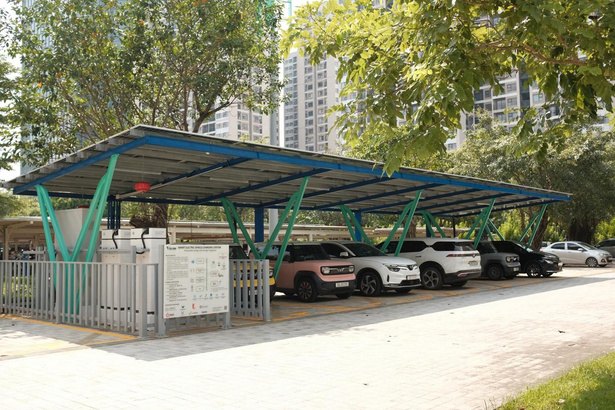
Volterra allocates power in real time, cutting energy and operating costs and raising station utilisation.
Location
2 pilot stations at VinUni
Duration
> 1 year of trials (3/2025 – 9/2026)
Scale
Standard 5-charger station
−40%
charging cost in the pilot
25–30%
lower electricity cost via EMS + DLM + AI
2–3 yrs
shorter payback period
From regional deployments to nationwide scale
The system is in live operation and ready to scale.
00
companies
under contract for Volterra services
00
pilots
deployed and verified for over a year
0%
operational stability
server system complete, built to scale
0
charging stations / points
under contract for Volterra services
0+
charging sessions
recorded, processed and optimised
00
cities / regions
deployed
VIVision & targets to 2030
What 50,000 Eco EV Charging Stations 2.0 mean for Vietnam
Green energy will shape the future of cities, accounting for 30% of Vietnam's total energy consumption. Volterra positions itself at the front of this transition with core technologies for urban infrastructure, contributing to Vietnam's Net Zero 2050 pathway.
0
Eco EV Charging Stations 2.0 converted across Vietnam
0MW+
renewable energy contributed
0MW+
total energy storage capacity
0M
kilometres driven on electricity
~0
households supplied with electricity each year
Targets stated in Volterra's 2030 vision
VIIClimate expectations · carbon credits
Every converted station is a measurable source of emission reductions
The Eco EV Charging Station 2.0 model cuts CO₂ through three mechanisms — and because Volterra measures every kWh, those reductions can be reported, verified and, in time, traded as carbon credits.
On-site renewables displace grid power
Solar + BESS at the station: each MWh generated on site avoids 0.66 tCO₂ from Vietnam's grid. Target: 500 MW+ by 2030.
Charging shifted into clean hours
DLM + AI forecasting move charging into midday solar surplus and off-peak hours, so fewer peaking thermal plants run. Absorbs renewable energy that would otherwise be curtailed.
Electric kilometres replace petrol kilometres
Every 1,000 km driven on electricity instead of petrol avoids ~40 kgCO₂ on today's grid — and ~160 kgCO₂ when charged from on-site solar. Target: 150M km by 2030.
Expected impact by number of stations converted
Eco EV Charging Stations 2.0 converted
50,000
500 MWp
on-site solar capacity · per year
700,000 MWh
clean electricity generated · per year
467,642 tCO₂
CO₂ avoided · per year
467,642
potential carbon credits (1 credit = 1 tCO₂e) · per year
2.3–9.4 M USD
credit value at 5–20 USD/tCO₂ · per year
203,322
petrol cars taken off the road (equivalent) · per year
Households supplied: 80,000 · Electric km: 150 M km
Assumptions behind these numbers
- Per-station ratios derived from Volterra's 2030 targets ÷ 50,000 stations: 10 kWp solar, 3,000 electric km and 1.6 households per station.
- Solar yield 1,400 kWh/kWp/year (conservative for Vietnam; the south exceeds 1,500).
- Grid emission factor 0.6592 tCO₂/MWh — Vietnam 2023, published by the Department of Climate Change (Official Letter 1726/BĐKH-PTCBT, 2024).
- Petrol car 0.16 kgCO₂/km (7 L/100 km × 2.31 kg/L); EV 0.18 kWh/km charged from the grid.
- Credit price 5–20 USD/tCO₂: the range of Vietnamese transactions 2023–2026 (forest REDD+, mangrove and low-emission rice programmes).
- BESS peak shaving is not counted (peak-hour marginal emissions are higher) — a deliberate safety margin.
Illustrative estimate based on Volterra's stated 2030 targets and public assumptions; not a commitment. CO₂ avoided only becomes a tradable credit after registration under an approved methodology, MRV and third-party verification.
From measured kWh to a tradable credit
A carbon credit is only as good as the data behind it. Volterra's stack already produces MRV-grade data: VolSense measures, IntegPower X records and reports, and the same platform coordinates the charging that creates the reductions.
Measure
kWh from solar, BESS, grid and every charging session — VolSense at the station.
Report
IntegPower X consolidates baseline vs. actual emissions per station and per network.
Verify
Independent verification under an approved methodology (domestic offset mechanism or international standards).
Trade
Vietnam's carbon exchange: pilot at HNX until 2028, official operation from 2029 (Decision 232/QĐ-TTg; Decree 29/2026/NĐ-CP).
Vietnam carbon market milestones
2025
Decision 232/QĐ-TTg: carbon market roadmap approved
2026
Decree 29/2026: rules for the exchange; pilot trading opens at HNX
2029
Official nationwide operation
2030
Volterra: 50,000 stations · 500 MW+ renewables
VIIITechnological self-reliance
Energy security also means owning the technology
All of Volterra's core technology — sensing hardware, edge gateway, the IntegPower X platform and its optimisation algorithms — is researched, developed and fully owned by Volterra's engineering team in Vietnam.
VolSense
Precise real-time measurement
VolNexus
Connect & process data at the edge
VolRemote
Remote control & coordination
IntegPower X
EMS · DLM · Digital Twin · AI forecasting
Runner-up — Techfest Vietnam 2025
Vietnam's largest national innovation and start-up festival, organised by the Ministry of Science and Technology.
1st Prize — Global Sustainability Challenge
Stanford Doerr School of Sustainability × HKUST. Winner of the Asia-Pacific final in Hangzhou, ahead of 60+ teams from China, Singapore and Hong Kong.
Best Start-up — UniVentures 2025
Block71 × NUS × Golden Gate Ventures. Top 2 of 10 national finalists; USD 25,000 prize and a 3-month incubation in Singapore.
“For a smart, flexible and sustainable energy system — serving economic growth and Vietnam's Net Zero goal.”